


Up to 25% weight loss
Triple agonist
Retatrutide
Retatrutide: New triple agonist GLP-1
A once-weekly injectable for weight management in adults
Triple agonist activates receptors for GIP, GLP-1 and glucagon
Not available in the UK
Used alongside a reduced-calorie diet and increased physical activity
What is retatrutide?
Injectable
Up to 25% weight loss
Triple agonist GLP-1
Retatrutide is an once-weekly triple hormone receptor agonist. Retatrutide is a single molecule that activates the body's receptors for glucose-dependent insulinotropic polypeptide (GIP), glucagon-like peptide-1 (GLP-1) and glucagon.
Retatrutide is currently not yet available for public use.

What is retatrutide?
How does retatrutide work?
Is Retatrutide available in the UK?
How to avoid buying unregulated versions of retatrutide online
How UK approval works
Results vary from person to person. How much weight you lose depends on your dose, how consistently you take the medicine, and the diet and activity changes you make alongside it. Retatrutide will be a treatment aid used alongside lifestyle change, not a replacement for it.
Retatrutide clinical trial results
The TRIUMPH-1 trial results were first announced in May 2026 and published in full in the New England Journal of Medicine in September 2026. They showed that retatrutide could help patients lose around a quarter of their body weight, and close to a third for some patients who continued treatment for longer.
The study included 2,339 adults with obesity or overweight who did not have type 2 diabetes. They were treated for 80 weeks.
The published paper's main analysis counts everyone who started the trial, including people who stopped treatment early. The table also shows Eli Lilly's figures for people who stayed on treatment as intended, which is the effect you'd expect if you keep taking it.
Other health benefits measured during retatrutide trials
The trial also measured other health benefits. People with knee osteoarthritis reported less knee pain. People with obstructive sleep apnoea had substantially fewer breathing interruptions per hour while asleep, around 32–34 fewer on the 9 mg and 12 mg doses compared with about 10 fewer on placebo.
Most common side effects reported during trials
The most common side effects were gastrointestinal: nausea, diarrhoea, constipation and vomiting. These were mostly mild to moderate and resolved during treatment. Around 11% of people on the 12 mg dose stopped treatment because of side effects, compared with about 5% on placebo.
Retatrutide dosage and administration
Like other weight management medications in its class, Retatrutide is designed as an injectable treatment. It is administered once weekly via a subcutaneous injection. This means it goes just under the skin rather than into a muscle or vein.
If approved, it will likely come in a pre-filled pen device, similar to devices used for Mounjaro and Wegovy. As with other weight loss injections, consistency will be important, so taking it on the same day each week helps maintain steady levels of the drug in your system.
Each clinical trial showed patients starting at different doses. Phase 2 trials started at 1mg where as Phase 3 trials started at 2mg.
There isn't an official confirmation of Retatrutide strengths or dosing schedule yet, as it's still being studied. However, like other weight loss injections, it was given at a low starting dose in trials and increased gradually over several weeks. This step-by-step approach allows the body to adjust to the medication and helps reduce the chance of side effects
Retrutide starting and titration schedule
To give your body time to adjust, treatment does not start at the maximum dose. You will likely begin on a low starting dose of 4mg.
If you tolerate the medication well, your clinician will gradually increase the dosage every four weeks. This step-by-step approach, known as titration, is crucial for minimising side effects while slowly building up to the therapeutic maintenance dose where maximum weight loss occurs.
Always follow your prescriber's instructions.
Any dose schedule shown here is a general guide. Your own dose, and how quickly it increases, will be set by your prescriber based on your individual response and tolerability.
Retatrutide side effects
Side effects of retatrutide
How to manage the side effects of retatrutide
How does retatrutide compare to Wegovy and Mounjaro
Understanding where retatrutide fits in the hierarchy of weight loss drugs helps manage expectations. No trial has tested retatrutide directly against other GLP-1s, so this is a comparison across separate trials rather than head-to-head evidence.
Retatrutide vs. Mounjaro
Mounjaro
KwikPen

Active ingredient: Tirzepatide
Dual action: GLP-1 and GIP
Weekly injection
Foundayo
(Orforglipron)
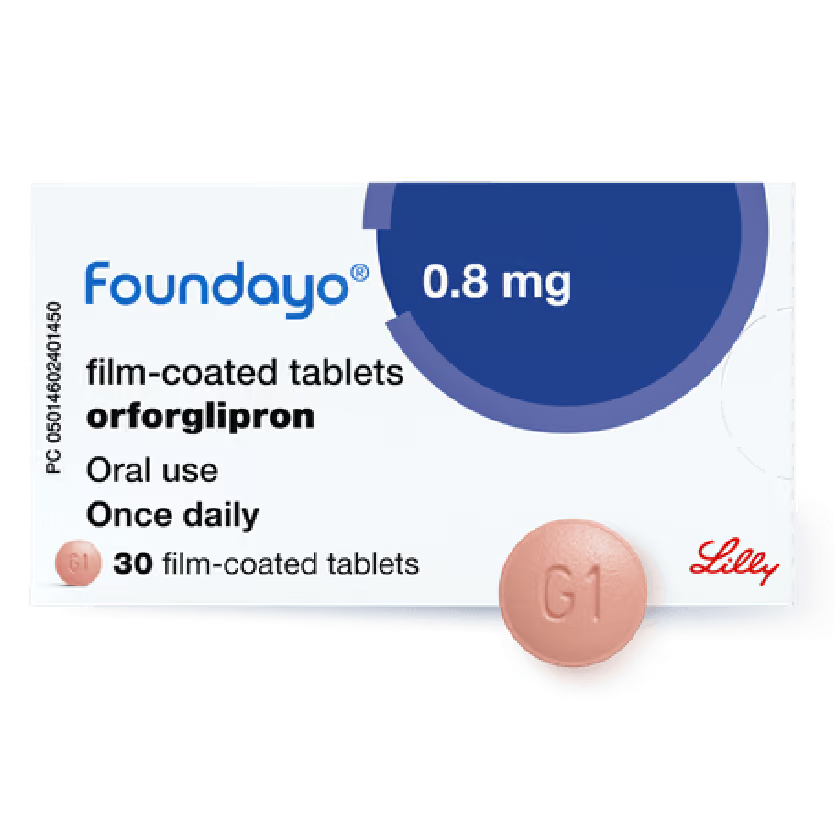
Active ingredient: Orforglipron
Single action: GLP-1
Daily tablet
Mounjaro is a dual agonist, targeting both the GLP-1 and GIP receptors. In the SURMOUNT-5 trial it produced 20.2% average weight loss at 72 weeks and is currently the most effective weight-loss drug on the market.
Retatrutide's triple mechanism adds glucagon receptor agonism on top of tirzepatide's GLP-1/GIP combination. TRIUMPH-1's 28.3% at 80 weeks (rising to 30.3% at 104 weeks in patients who continued treatment) is meaningfully higher than tirzepatide's published results, suggesting retatrutide could set a new bar for the class.
While Retatrutide appears more effective, Tirzepatide and Semaglutide are proven, safe, and available now. For many patients, the dual action of Tirzepatide provides ample support for reaching a healthy weight without waiting for future drugs.
Retatrutide vs Wegovy
Mounjaro
KwikPen
Active ingredient: Tirzepatide
Dual action: GLP-1 and GIP
Weekly injection
Foundayo
(Orforglipron)
Active ingredient: Orforglipron
Single action: GLP-1
Daily tablet
Wegovy is a single-hormone agonist that targets the GLP-1 receptor. It is the most established of the three, with years of real-world use, and its own pivotal trials showed average weight loss of around 15% of body weight.
Retatrutide adds two further mechanisms on top of GLP-1: agonism at the GIP and glucagon receptors. On the current evidence, that broader mechanism translates into a substantially larger effect – the Phase 3 TRIUMPH-1 trial reported 28.3% average weight loss at 80 weeks (24.2% in the earlier Phase 2 trial at 48 weeks), roughly double semaglutide's published figures.
Retatrutide FAQs
Who should avoid Retatrutide?
How does Retatrutide impact blood sugar in people without diabetes?
What is the expected cost of Retatrutide in the UK?
Can Retatrutide preserve muscle mass during weight loss?
How long do Retatrutide side effects typically last?
References
Retatrutide, a Triple Hormone Receptor Agonist, for Treatment of Obesity. New England Journal of Medicine. Published 29 September 2026. DOI: 10.1056/NEJMoa2604169. Available at: https://www.nejm.org/doi/full/10.1056/NEJMoa2604169
Eli Lilly and Company. Lilly's triple agonist, retatrutide, delivered powerful weight loss in pivotal Phase 3 obesity trial. Available at: https://www.prnewswire.com/news-releases/lillys-triple-agonist-retatrutide-delivered-powerful-weight-loss-in-pivotal-phase-3-obesity-trial-302778859.html
Eli Lilly and Company Investor Relations. Lilly's triple-agonist retatrutide delivered weight loss average. Available at: https://investor.lilly.com/news-releases/news-release-details/lillys-triple-agonist-retatrutide-delivered-weight-loss-average
National Center for Biotechnology Information (PMC). Available at: https://pmc.ncbi.nlm.nih.gov/articles/PMC12026077/
Medicines and Healthcare products Regulatory Agency (MHRA). How we regulate. Available at: https://www.gov.uk/government/organisations/medicines-and-healthcare-products-regulatory-agency
National Institute for Health and Care Excellence (NICE). How NICE evaluates new medicines. Available at: https://www.nice.org.uk

Reviewed by:
Last reviewed:
10 October 2026
Next review:
July 30, 2027
How can we help