

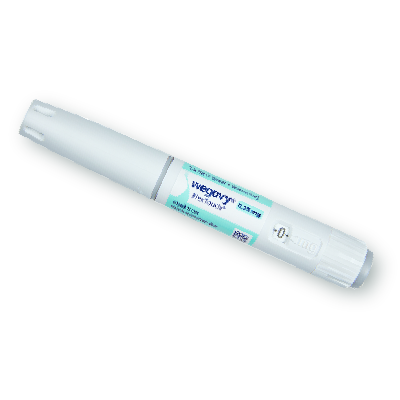

If you’ve heard that Wegovy simply “switches off your appetite”, that’s only part of the picture. It’s correct that Wegovy does reduce appetite, and it's often the effect people notice first, but it's one outcome of a much broader mechanism. Semaglutide, the active ingredient in Wegovy, is a GLP-1 receptor agonist that acts on multiple sites across the body simultaneously, including the brain, the stomach and the pancreas.
Understanding the semaglutide mechanism of action matters because it helps explain why the results go well beyond simply eating less. It also helps patients make sense of what they’re experiencing day to day.
The short answer: Wegovy works through four overlapping pathways:
- Brain signalling: strengthening the body’s natural satiety signals and reducing food cravings
- Slower gastric emptying: keeping food in the stomach longer so fullness lasts
- Glucose-dependent insulin release: supporting the pancreas to respond to blood glucose rises after meals
- Glucagon suppression: reducing the liver’s release of excess glucose between meals
What is Wegovy, and what does semaglutide do?
Wegovy is the brand name for semaglutide, a weekly injectable medicine licensed in the UK for weight management in adults with obesity or overweight with at least one weight-related health condition. Semaglutide belongs to a class of medicines called GLP-1 receptor agonists.
GLP-1 stands for glucagon-like peptide-1. It’s a hormone your body produces naturally in the small intestine after eating. Its job is to tell the brain you’re full, slow down digestion, prompt the pancreas to release insulin, and prevent the liver from releasing too much glucose.
The problem is that natural GLP-1 breaks down within minutes. Semaglutide is engineered to mimic GLP-1 but last much longer.
How does semaglutide work? The four main mechanisms
Understanding the Wegovy mechanism of action means looking at each of these four pathways in turn.
1. Brain signalling and quietening food noise
GLP-1 receptors are found throughout the brain, including in the hypothalamus and brainstem, the regions responsible for regulating hunger and fullness. When semaglutide activates these receptors, it strengthens the body’s natural “stop eating” signals.
UAB researchers studying GLP-1 drugs found that appetite suppression from these medicines is fundamentally brain-mediated. Preclinical studies showed that restricting GLP-1 drug activity to the brain alone still produced reduced food intake, confirming the central nervous system is where much of the effect originates.
Beyond reducing hunger, semaglutide also appears to blunt the brain’s dopamine-driven reward response to highly palatable food. Foods that once felt irresistible may simply feel less compelling. This is why many patients describe a reduction in cravings and “food noise” rather than just feeling full.
2. Slower gastric emptying
Semaglutide slows the rate at which food moves from the stomach into the small intestine. This delays the absorption of nutrients and extends the sensation of fullness after a meal.
A placebo-controlled trial cited in a 2025 PMC review of semaglutide’s clinical applications confirmed that semaglutide significantly delayed gastric emptying compared with placebo, using a procedure that scans inside the body (scintigraphy) to measure the effect directly. The practical result: meals feel more satisfying for longer, and the urge to snack between meals reduces.
3. Glucose-dependent insulin release
When blood glucose rises after eating, semaglutide prompts the pancreas to release more insulin. Crucially, this effect is glucose-dependent, meaning it only activates when blood sugar is actually elevated. When glucose levels are normal, the insulin-stimulating effect is minimal.
This is clinically important. It means semaglutide supports blood sugar regulation without the risk of driving glucose too low, which is a concern with some other diabetes and weight-related medications.
4. Glucagon suppression
Glucagon is a hormone produced by the pancreas that signals the liver to release stored glucose into the bloodstream. Between meals, excess glucagon can keep blood sugar unnecessarily elevated.
Semaglutide reduces glucagon release from pancreatic alpha cells, helping to lower fasting glucose levels and reduce the liver’s contribution to blood sugar fluctuations. This metabolic effect operates independently of appetite, and it helps explain why semaglutide has effects that go well beyond portion control.
Why appetite suppression is only part of the story
Appetite reduction is the most noticeable effect because it’s the one patients feel directly. Eating less, feeling full sooner, losing interest in snacks — these are tangible changes that happen relatively early in treatment. It’s natural to assume that’s the whole story.
But the weight loss outcomes from semaglutide can’t be explained by appetite alone. The metabolic effects on blood glucose, gastric emptying and glucagon all contribute. The 2025 PMC review describes semaglutide’s effects as extending “beyond the pancreas” to include weight loss, cardiometabolic changes and systemic effects — a picture that’s considerably more complex than simple appetite suppression.
The table below separates common misconceptions from what the evidence actually shows:
The distinction matters clinically. Patients who understand the full mechanism are better placed to have realistic expectations, manage side effects appropriately, and stay committed to treatment during the dose titration phase.
What patients may notice in real life
Knowing the science is one thing. Understanding what it feels like in practice is another. The four mechanisms above tend to translate into a set of changes patients commonly report:
Changes patients commonly report:
- Earlier fullness at meals — smaller portions feel satisfying in a way they didn’t before, because gastric emptying is slower and satiety signals are stronger
- Reduced cravings and food noise — the constant mental pull towards snacking or high-calorie foods quietens, linked to the blunting of the brain’s dopamine reward response to food
- Less interest in previously appealing foods — takeaways, sweets or crisps may feel less compelling rather than actively unpleasant
- More stable appetite patterns — rather than sharp hunger spikes, many patients describe a steadier, lower baseline of hunger across the day
- Gradual rather than immediate changes — as Phlo Clinic’s first-month guide explains, early weeks focus on adjustment and tolerance rather than maximum effect
A note on nausea: Some patients experience nausea, particularly in the early weeks of treatment. This is a side effect of slower gastric emptying, not evidence that the treatment is working harder. It typically improves as the body adjusts to each dose level. Nausea is not the mechanism, and it’s not something to push through unnecessarily. Contact your prescribing pharmacist if it's persistent or severe.
Ready to find out if Wegovy is right for you?
Semaglutide works through a combination of mechanisms, but whether it’s appropriate depends on your individual health profile. Eligibility criteria include BMI, weight-related health conditions and medical history.
Phlo Clinic’s prescribing pharmacists assess every patient individually and support you throughout your treatment, from dose titration to ongoing check-ins.
Find out more about Wegovy at Phlo Clinic and speak to a prescribing pharmacist about whether it’s the right option for you.
References
- Highlights of Prescribing Information: Wegovy (semaglutide) injection. U.S. Food and Drug Administration. Available at: https://www.ncbi.nlm.nih.gov/books/NBK603723/
- Semaglutide. StatPearls. National Center for Biotechnology Information. Available at: https://www.ncbi.nlm.nih.gov/books/NBK603723/
- The GLP-1 revolution: What UAB researchers are discovering about how these drugs work. University of Alabama at Birmingham. Available at: https://www.uab.edu/news/research-innovation/the-glp-1-revolution-what-uab-researchers-are-discovering-about-how-these-drugs-work
- The multifaceted effects of semaglutide: exploring its broad clinical applications. PMC, 2025. Available at: https://pmc.ncbi.nlm.nih.gov/articles/PMC12413075/
- Wegovy (semaglutide): a new weight loss drug for chronic weight management. PMC. Available at: https://pmc.ncbi.nlm.nih.gov/articles/PMC8717485/
- STEP 1: Research Study Investigating How Well Semaglutide Works in People Living With Overweight or Obesity. ClinicalTrials.gov. Available at: https://clinicaltrials.gov/study/NCT03548935
- What is Wegovy and How Does It Work? Phlo Clinic. Available at: https://phloclinic.co.uk/weight-loss-service/advice/wegovy-guides/wegovy-guide
- What to Expect in Your First Month on Wegovy. Phlo Clinic. Available at: https://phloclinic.co.uk/weight-loss-service/advice/wegovy-guides/what-to-expect-in-your-first-month-on-wegovy
