

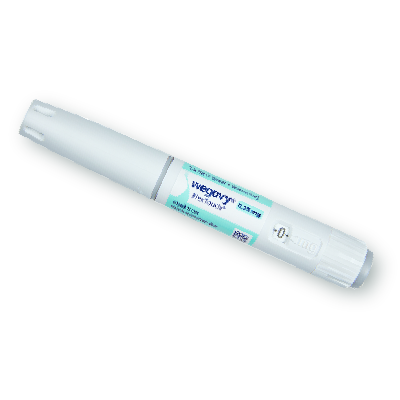

Wegovy has become one of the most talked-about weight loss treatments in the UK, and the attention is not without reason. The clinical results are, by any honest measure, significant. But between the headlines and the hype, a lot of important detail gets lost. How much weight do people actually lose? What happens when they stop? And what does the evidence say about who benefits most?
This article works through the clinical data clearly, so you can make an informed decision rather than one based on expectation alone.
Key takeaway: Wegovy produces meaningful, clinically significant weight loss in most people who take it consistently. But it works best as part of a structured, medically supported programme, not as a standalone fix.
What is Wegovy and how does it work?
Wegovy is the brand name for semaglutide, a once-weekly injection developed by Novo Nordisk for chronic weight management. It belongs to a class of medicines called GLP-1 receptor agonists (glucagon-like peptide-1), which mimic a hormone your body naturally produces after eating.
When you inject Wegovy, it acts on receptors in the brain that regulate appetite and satiety, making you feel fuller faster and reducing the persistent background thoughts about food that many people describe as "food noise." It also slows gastric emptying, meaning food stays in your stomach longer, which extends the feeling of fullness after meals.
Who is it prescribed for in the UK?
In the UK, Wegovy is approved by the Medicines and Healthcare products Regulatory Agency (MHRA) for adults who meet specific clinical criteria:
- A BMI of 30 kg/m² or above (obesity), or
- A BMI of 27 kg/m² or above (overweight) with at least one weight-related health condition, such as type 2 diabetes, high blood pressure, or high cholesterol
- Used alongside a reduced-calorie diet and increased physical activity
It is a prescription-only treatment, which means only a qualified prescriber must assess your suitability before you can start.
What the clinical trials actually show about Wegovy effectiveness
The evidence base for Wegovy is substantial. The STEP (Semaglutide Treatment Effect in People with obesity) programme is the most comprehensive set of clinical trials ever conducted for a weight loss medication, involving thousands of participants across multiple countries.
STEP 1: the headline results
The landmark STEP 1 trial (Wilding et al., N Engl J Med, 2021), enrolled 1,961 adults with obesity and no diabetes. After 68 weeks:
- Participants on Wegovy 2.4mg lost an average of 14.9% of their body weight
- The placebo group lost just 2.4%
- Nearly 70% of Wegovy participants lost 10% or more of their body weight
- Around one in three lost 20% or more
To put that in context: a person weighing 100kg could expect to lose approximately 15kg on Wegovy, compared to around 2-3kg on placebo with lifestyle changes alone.
STEP 3 and beyond
The STEP 3 trial (Wadden et al., JAMA, 2021), which combined Wegovy with intensive behavioural support, showed even stronger outcomes, with participants losing an average of 16% of body weight over 68 weeks. This is a critical finding. The medication amplifies results when it is part of a structured programme, not a replacement for one.
The consistent finding across the STEP trials: average weight loss of 12-15% over 68 weeks, with a meaningful proportion of patients achieving 20% or more.
The new 7.2mg dose: STEP UP results
In January 2026, the MHRA approved a higher-dose version of Wegovy at 7.2mg. This was based on the STEP UP Phase IIIb trial (published in Lancet Diabetes & Endocrinology, 2025; ClinicalTrials.gov: NCT05646706), which enrolled 1,407 adults with obesity and a BMI of 30 and above at initiation of treatment, across 11 countries who had not reached their weight loss goals on the standard 2.4mg maintenance dose.
The results were notable:
The results were notable. This brings Wegovy's ceiling closer to that of other GLP-1 treatments, and gives patients who plateau on the standard dose a clinically supported next step.
Beyond weight loss: the broader health benefits
Wegovy's effectiveness is not limited to the number on the scales. The clinical evidence points to meaningful improvements in several obesity-related health conditions, which matters because obesity rarely exists in isolation.
Cardiovascular protection
In 2024, the MHRA approved Wegovy for an additional indication: reducing the risk of serious cardiovascular events, including heart attack and stroke, in adults with obesity or overweight who have established cardiovascular disease. This was based on the SELECT trial (Lincoff et al., N Engl J Med, 2023), which followed over 17,000 participants for an average of more than three years.
The result: Wegovy reduced the risk of major cardiovascular events by 20% compared to placebo, independent of weight loss alone. This is a significant finding because it suggests semaglutide has direct cardioprotective effects beyond simply reducing body weight.
For more detail on this, our guide to Wegovy and heart health covers the evidence in depth.
Improvements in metabolic health markers
Across the STEP trials, participants on Wegovy consistently showed improvements in:
- Blood pressure: reductions in both systolic and diastolic readings
- Blood glucose control: lower HbA1c levels, with some participants reversing pre-diabetes
- Cholesterol: reductions in LDL (harmful) cholesterol and triglycerides
- Waist circumference: an average reduction of around 13cm in head-to-head trial data
These are not cosmetic outcomes. They represent a meaningful reduction in the long-term disease burden associated with obesity, which affects approximately 15 million adults in the UK according to NHS data.
The honest caveats: what Wegovy can't do
The clinical data is compelling, but a complete picture of Wegovy's effectiveness has to include what happens when things don't go to plan. There are three areas worth understanding clearly.
Side effects are common, especially early on
The most frequently reported side effects of Wegovy are gastrointestinal: nausea, vomiting, diarrhoea, constipation, and abdominal discomfort. These are most pronounced during the dose escalation phase (the first 16-20 weeks as doses increase from 0.25mg to the 2.4mg maintenance dose) and tend to ease once a stable dose is reached.
In the STEP trials, around 7% of participants discontinued treatment due to side effects. For most people, these symptoms are manageable with the right guidance on timing, diet, and dose adjustments. Our Wegovy side effects guide covers the most common experiences and how to manage them.
Not everyone responds equally
Clinical averages mask a wide range of individual responses. While the average weight loss across STEP 1 was 14.9%, some participants lost significantly more and others considerably less. Factors that influence response include:
- Starting weight and BMI
- Presence of type 2 diabetes (which tends to reduce the weight loss effect)
- Adherence to the dose escalation schedule
- Lifestyle factors: diet quality, physical activity, sleep, and stress management
The real-world implication: Wegovy is not a guaranteed outcome. It's a tool that, used well within a supported programme, delivers significant results for most people.
Weight regain after stopping
This is the most important caveat, and it's one that deserves plain-speaking. A 2022 extension of the STEP 1 trial (Wilding et al., Diabetes, Obesity and Metabolism, 2022) found that participants who stopped Wegovy after 68 weeks of treatment regained an average of two-thirds of the weight they had lost within one year of stopping. A separate trial showed that stopping semaglutide at week 20 led to a weight gain of nearly 7%, while those who continued lost a further 8%.
The reason is biological, not a failure of willpower. Wegovy works by supplementing a hormonal signal your body produces naturally. When you stop taking it, appetite returns to its previous baseline, food noise resurfaces, and the metabolic changes that drove weight loss begin to reverse.
This does not mean Wegovy is ineffective. It means it behaves like most treatments for chronic conditions: it works while you're taking it, and the benefits require ongoing management. Approaching it as part of a long-term health plan, rather than a short course, is what the evidence supports.
How does Wegovy compare to Mounjaro (tirzepatide)
The SURMOUNT-5 trial (Aronne et al., N Engl J Med, 2025), the first head-to-head comparison of Wegovy and Mounjaro, enrolled 751 adults with obesity and no diabetes. The results showed:
- Mounjaro: average weight loss of 20.2% over 72 weeks
- Wegovy: average weight loss of 13.7% over 72 weeks
- 32% of Mounjaro participants lost 25%+ of body weight, vs 16% on Wegovy
Mounjaro works on two appetite-regulating pathways (GIP and GLP-1), which is thought to explain its stronger effect. However, Wegovy has a distinct advantage: it is the only weight loss injection currently approved by the MHRA to reduce cardiovascular risk, making it the preferred option for patients with existing heart disease.
With the new 7.2mg dose now approved, Wegovy's weight loss ceiling (up to 20.7%) is now comparable to Mounjaro's headline figure (20.9%). This narrows the gap considerably for patients who need additional weight loss beyond what the standard 2.4mg dose achieves.
For a detailed comparison of both treatments, see our guide: Is Mounjaro or Wegovy right for you?
The bottom line
Wegovy is genuinely effective. The clinical evidence is robust, the trials are large and well-designed, and the results hold up across different populations. Average weight loss of 14-15% on the standard dose, rising to over 20% with the new 7.2mg dose and full adherence, represents a step-change from anything available before the GLP-1 era.
Wegovy delivers clinically meaningful weight loss backed by some of the strongest evidence in obesity medicine. The key to making that evidence work for you is consistency, clinical oversight, and treating it as a long-term health decision rather than a quick result.
References
- Wilding JPH, et al. Once-Weekly Semaglutide in Adults with Overweight or Obesity. N Engl J Med. 2021;384(11):989-1002. doi:10.1056/NEJMoa2032183
- Wadden TA, et al. Effect of Subcutaneous Semaglutide vs Placebo as an Adjunct to Intensive Behavioral Therapy on Body Weight in Adults With Overweight or Obesity: The STEP 3 Randomized Clinical Trial. JAMA. 2021;325(14):1403-1413. doi:10.1001/jama.2021.1831
- Lincoff AM, et al. Semaglutide and Cardiovascular Outcomes in Obesity without Diabetes. N Engl J Med. 2023;389(24):2221-2232. doi:10.1056/NEJMoa2307563
- Wilding JPH, et al. Weight regain and cardiometabolic effects after withdrawal of semaglutide: The STEP 1 trial extension. Diabetes Obes Metab. 2022;24(8):1553-1564. doi:10.1111/dom.14725
- Aronne LJ, et al. Tirzepatide versus Semaglutide for Obesity (SURMOUNT-5). N Engl J Med. 2025. doi:10.1056/NEJMoa2504008
- STEP UP trial. Once-weekly semaglutide 7·2 mg in adults with obesity: a randomised, controlled, phase 3b trial. Lancet Diabetes Endocrinol. 2025;13(11):949-963. doi:10.1016/S2213-8587(25)00226-8 | ClinicalTrials.gov NCT05646706
- MHRA. Wegovy 7.2mg approved for chronic weight management in adults with obesity. January 2026. pharmaceutical-technology.com
- NHS. Obesity. nhs.uk/conditions/obesity
.png)