
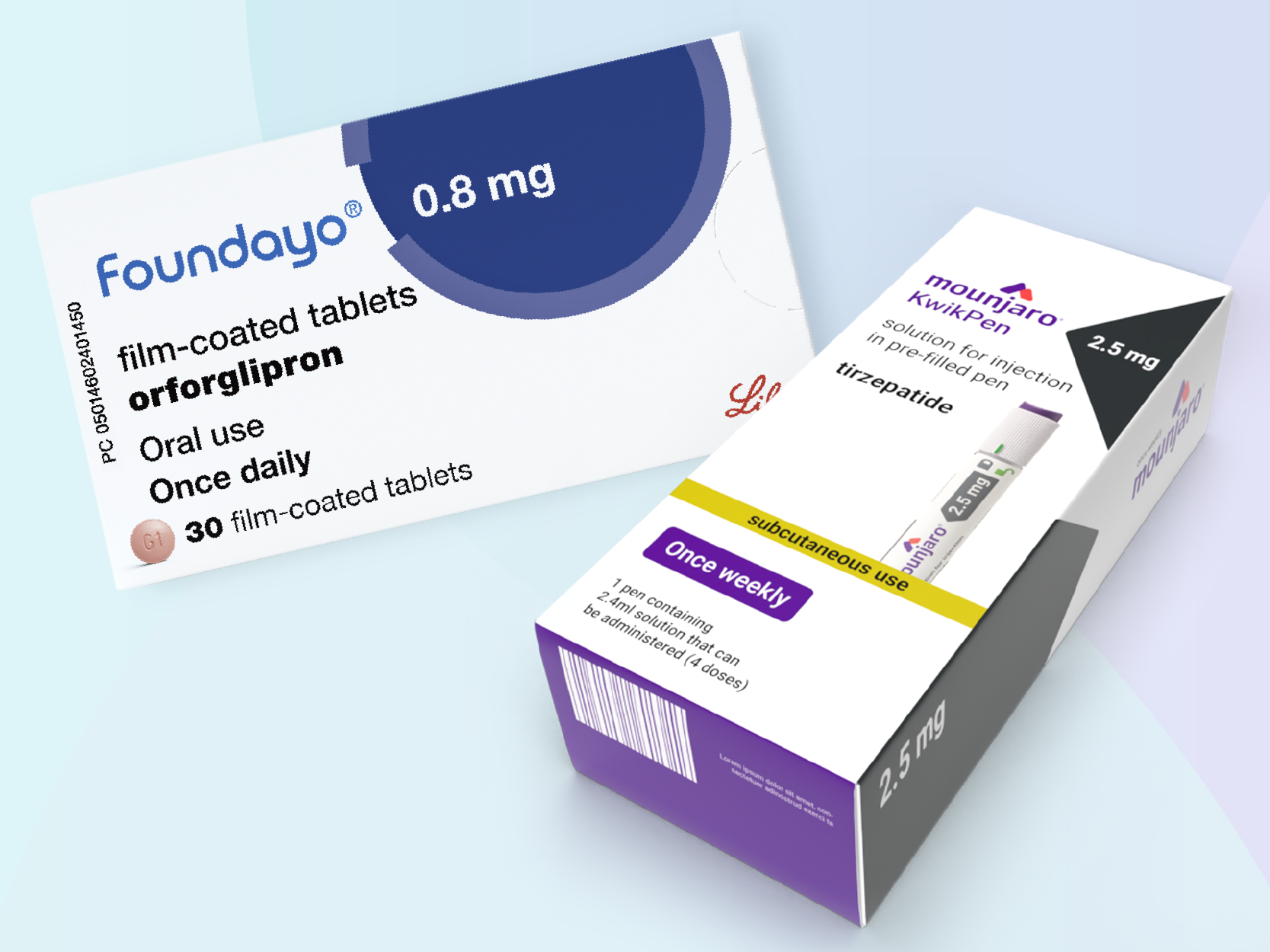
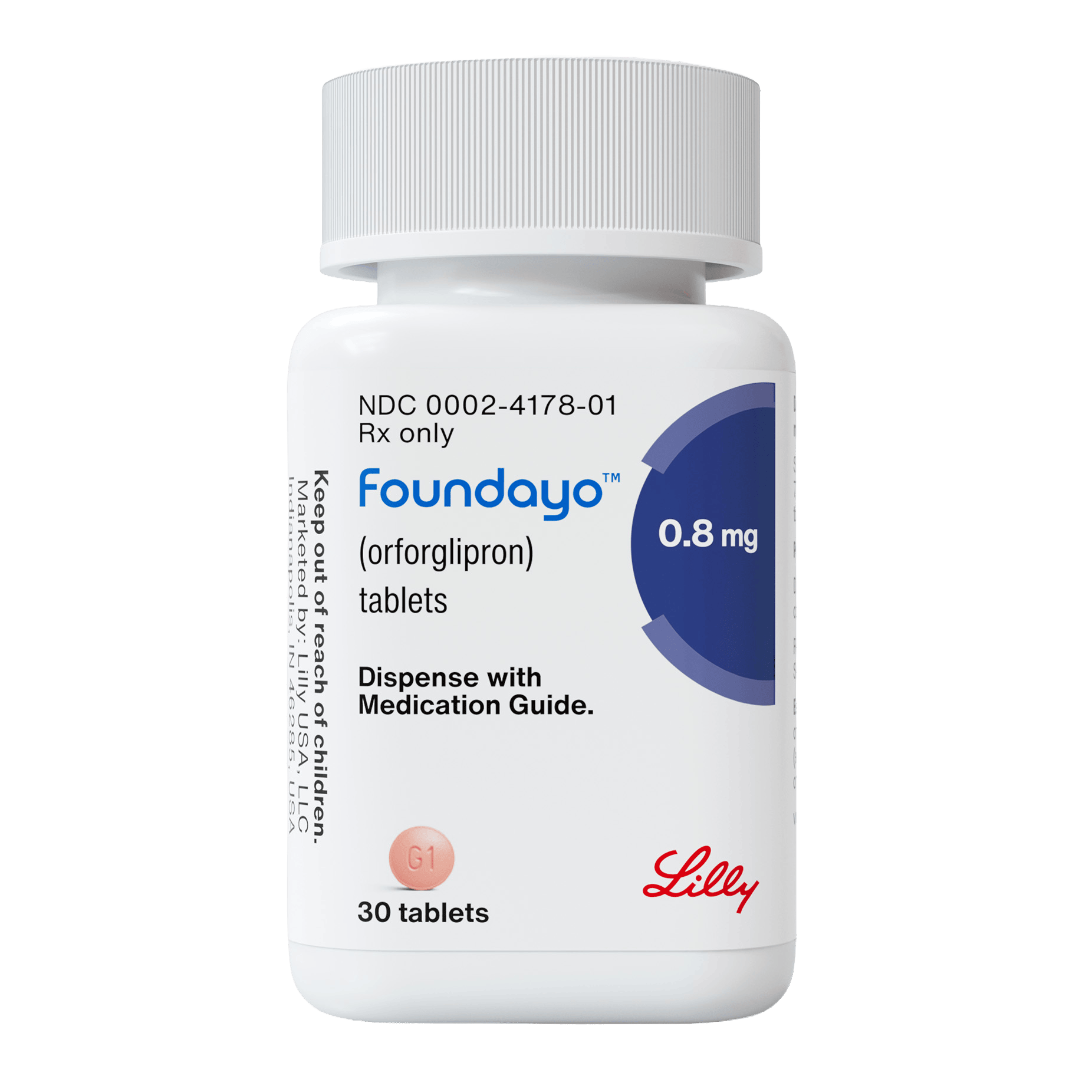
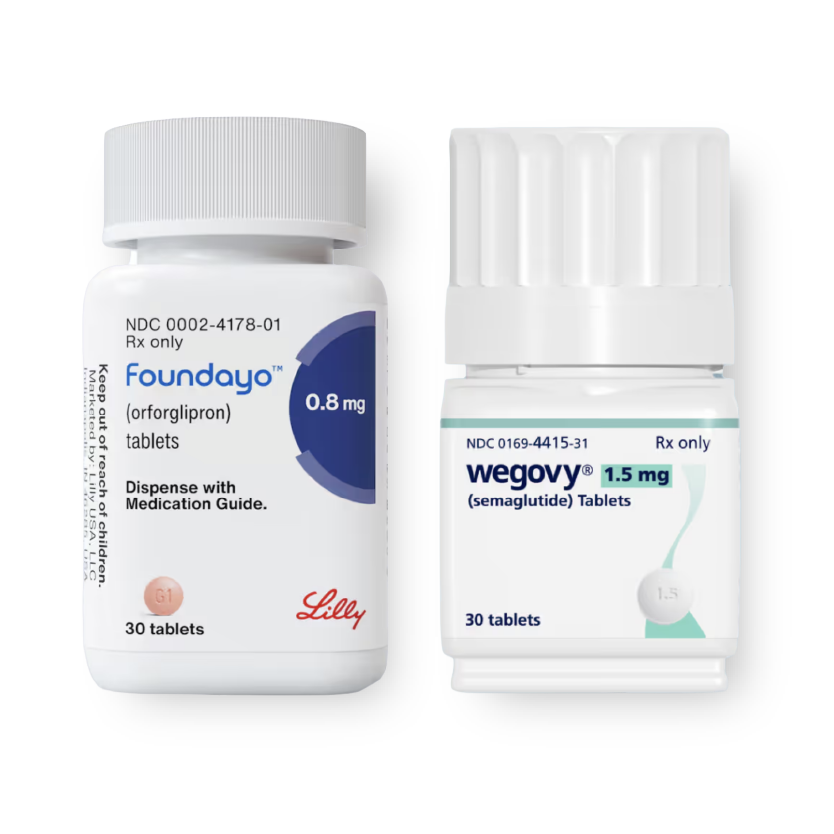
Orforglipron (Foundayo) is a once-daily tablet that works on one hormone pathway. Tirzepatide (Mounjaro) is a once-weekly injection that works on two. Both are now licensed in the UK.
On the evidence available today, tirzepatide has produced greater average weight loss. Orforglipron’s advantage is its format, not efficacy. There’s no needles or refrigeration required, and fewer rules about when you take it.
It’s also worth noting, there is no head-to-head trial between them, so the comparison is directional rather than definitive.
Until recently, choosing a GLP-1 treatment meant choosing between injections. That changed in August 2026, when Foundayo (Orforglipron) became the second oral GLP-1 licensed in the UK for weight management.
That makes the comparison with Mounjaro (tirzepatide) a real one for the first time. It’s also more nuanced than "pill versus injection," because the two medicines don’t work in quite the same way, and the trade-off between convenience and expected results is a genuine one.
Orforglipron vs tirzepatide at a glance
Figures come from separate trials with different participants and designs. There is no head-to-head study, so these are directional rather than a like-for-like comparison.
How they work: one targets GLP-1 only, the other targets GLP-1 and GIP
Both medicines work by mimicking hormones your gut releases after eating which signals to your brain you’ve had enough. Where they differ is how many of those signals they act on.
Orforglipron activates GLP-1 receptors only. This reduces appetite, slows how quickly your stomach empties, and helps you feel fuller for longer.
Tirzepatide activates two receptors, GLP-1 and GIP. Your body releases both hormones together after a meal, and activating both produces a stronger, more complete signal than either alone.
This dual action is generally understood to be why tirzepatide (Mounjaro) has produced greater average weight loss in trials. It isn’t simply a higher dose of the same thing; it’s a different mechanism.
The practical point for patients is this: two medicines in the same broad family are not interchangeable, and you shouldn’t assume a tablet and an injection perform equally just because both are called GLP-1 treatments.
Weight loss results
There is no head-to-head trial comparing orforglipron with tirzepatide in obesity. Everything below comes from separate trials, with different participants, designs and durations. The figures are directional, not a like-for-like measurement.
Orforglipron
In the pivotal ATTAIN trial, 3,127 adults with obesity or overweight with a weight-related condition, without type 2 diabetes, took orforglipron for roughly 72 weeks alongside diet and activity changes.
Those on the highest dose lost around 11–12% of their body weight on average, compared with 1–2% on placebo. The precise figure depends on how the data is read: about 12.4% versus 0.9% counting only those who stayed on treatment throughout, and around 11% versus 2% counting everyone who enrolled.
Nearly 60% of people on the highest dose lost at least 10% of their starting weight, and around 40% lost at least 15%.
Tirzepatide
The SURMOUNT programme reported average weight loss of 21.4% at 10mg and 22.5% at 15mg over 72 weeks, compared with 2.4% on placebo. In participants with type 2 diabetes, where weight loss is typically harder to achieve, results were 13.4% and 15.7%.
What this means in practice
On the evidence available today, tirzepatide produces greater average weight loss. That gap is real and worth being straightforward about.
But averages describe groups, not individuals. What you lose depends on your dose, how consistently you take the treatment, and the diet and activity changes you make alongside it. The best treatment is the one you can tolerate and stay on, and that’s a conversation to have with a prescriber, not a comparison table.
Both medicines are treatment aids used alongside a reduced-calorie diet and increased physical activity, not replacements for them.
Side effects
Both medicines share the same broad side-effect profile, which is expected given they act on overlapping pathways.
The most commonly reported effects for both are gastrointestinal: nausea, vomiting, diarrhoea, constipation and indigestion. These are usually mild to moderate, most noticeable when starting treatment or moving up a dose and tend to settle as your body adjusts.
Both also carry the same class warnings: a boxed warning about a potential thyroid tumour risk, based on animal studies with other GLP-1 medicines rather than with either drug itself, and cautions around pancreatitis, gallbladder disease and dehydration. Neither is suitable for anyone with a personal or family history of medullary thyroid carcinoma or MEN 2, or during pregnancy and breastfeeding.
What differs is the pattern rather than the type. With a weekly injection, side effects tend to cluster in the day or two after each dose. With a daily tablet, any effect is spread more evenly across the week. Which of those is easier to manage is genuinely personal. Some people would rather have a predictable bad day; others prefer nothing sharp enough to plan around.
Seek urgent medical advice if you experience: severe or persistent abdominal pain (possible pancreatitis), signs of dehydration, or an allergic reaction.
Dosage scheduling and titration
Both treatments start low and increase gradually, and for the same reason: to let your body adjust and keep side effects manageable.
Orforglipron is taken once daily, at any time of day, with or without food. There are six strengths (0.8mg, 2.5mg, 5.5mg, 9mg, 14.5mg and 17.2mg) with at least 30 days at each step before an increase is considered.
Tirzepatide is injected once weekly, starting at 2.5mg and increasing in 2.5mg steps every four weeks up to a maximum of 15mg. It needs refrigerating and comes with needles and sharps disposal.
Neither is obviously more convenient, and it’s worth resisting the assumption that a tablet automatically wins. A daily tablet means having to remember every day of the week rather than just once a week, but it removes needles, storage and travel complications. A weekly injection is one appointment with yourself, but it’s an injection, which some patients dislike, while weekly dosing may feel simpler than remembering a daily tablet. Convenience matters, but it does not automatically outweigh efficacy, availability, and suitability.
Not everyone reaches the highest dose of either treatment. Settling at a lower maintenance dose is a normal outcome, not a sign something isn’t working.
Availability in the UK
Both treatments are now licensed here in the UK.
Tirzepatide has been licensed since November 2023. NICE recommends it under TA1026, and it’s available both privately and through a phased NHS rollout in England. NHS eligibility is narrower than the licence and there is a set threshold of BMI 35 or above with a weight-related condition, with lower thresholds for some ethnic groups, and NHS England’s guidance makes wraparound support a mandatory part of access.
Orforglipron was approved by the MHRA on 10 August 2026. It’s available on private prescription, and has not yet been through NICE appraisal, so there’s no NHS route at present.
For both, the licensed criteria are a BMI of 30 or above, or 27 or above with a weight-related health condition such as type 2 diabetes or high blood pressure.
Both are available through Phlo Clinic.
FAQ: common questions about orforglipron and tirzepatide
Is orforglipron available in the UK?
Yes. It was approved by the MHRA on 10 August 2026 and is available on private prescription. It hasn’t yet been appraised by NICE, so it isn’t available on the NHS.
Does orforglipron work better than tirzepatide?
No head-to-head trial exists. Across separate trials, tirzepatide has produced greater average weight loss. Orforglipron’s advantage is its format rather than its efficacy.
Will weight loss pills replace injections?
Unlikely to be a straight replacement. Oral options widen access for people who won’t or can’t inject, but on current evidence they haven’t matched the strongest injectables. Both are likely to have a place.
Can I switch from Mounjaro to orforglipron?
Switching is possible but needs clinical guidance. The two work differently, doses aren’t interchangeable, and moving across without support can mean more side effects or a period where treatment works less well. Speak to your prescriber first.
Which should I choose?
It depends on your medical history, what you can realistically sustain, and how you feel about injections. A prescriber can assess your suitability for both and help you weigh it up.
References
- Lilly’s oral GLP-1, orforglipron, delivers weight loss of up to an average of 27.3 lbs in first of two pivotal Phase 3 trials in adults with obesity. Available at: prnewswire.com. ATTAIN-1 topline: 12.4% mean weight loss at 72 weeks on the highest dose in adults with obesity or overweight without diabetes; once-daily oral dosing without food or water restrictions.
- Lilly’s oral GLP-1, orforglipron, is successful in third Phase 3 trial, triggering global regulatory submissions this year for the treatment of obesity. Available at: investor.lilly.com. ATTAIN-2 topline: 10.5% mean weight loss at 72 weeks in adults with obesity or overweight and type 2 diabetes; common adverse events included nausea, vomiting, diarrhoea, constipation, and dyspepsia.
- Lilly’s oral GLP-1, orforglipron, demonstrated statistically significant efficacy results and a safety profile consistent with injectable GLP-1 medicines in successful Phase 3 trial. Available at: investor.lilly.com. ACHIEVE-1 confirmed oral small-molecule GLP-1 mechanism, once-daily dosing without food or water restrictions, and GI tolerability profile consistent with the GLP-1 class.
- Tirzepatide for managing overweight and obesity | Guidance | NICE. Available at: nice.org.uk. NICE recommends tirzepatide for eligible adults with an initial BMI of at least 35 kg/m² and at least one weight-related comorbidity, with lower thresholds for some ethnic groups.
- Interim commissioning guidance – NHS England. Available at: england.nhs.uk. Explains the phased NHS rollout of tirzepatide in England and makes wraparound care a mandatory part of access.
- Is Mounjaro or Wegovy the right weight loss drug for me? Available at: phloclinic.co.uk. A plain-English mechanism comparison and internal context for how tirzepatide differs from a single-pathway GLP-1 medicine.

