
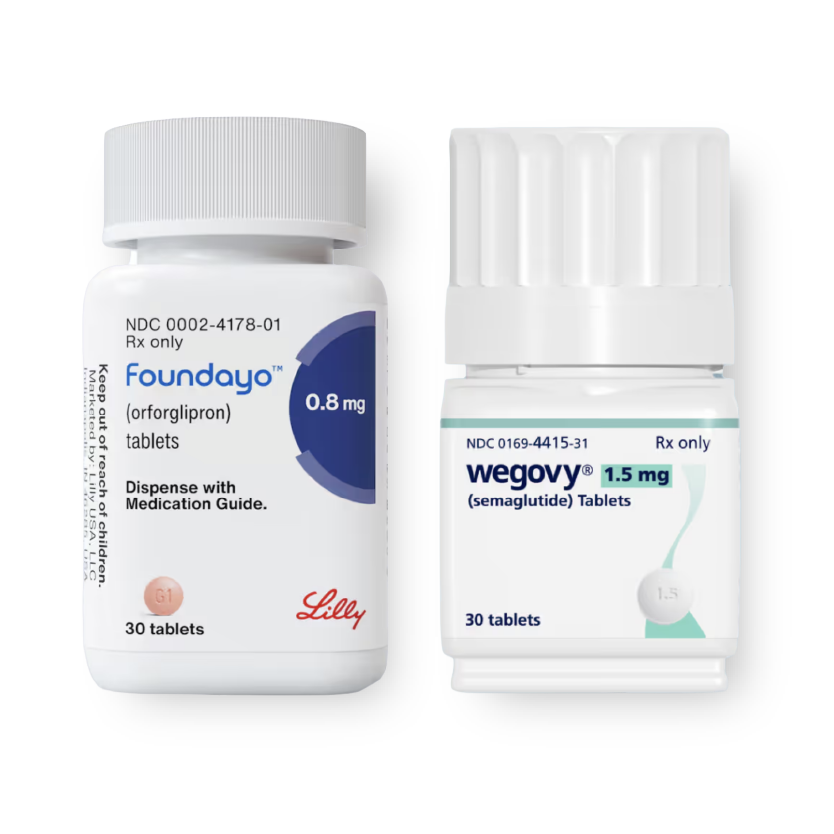
The approval of Foundayo (orforglipron) by the FDA on April 1st 2026 prompted me to look more closely at something that does not always receive the attention it deserves: the safety implications of drug name design. As a GLP-1 receptor agonist from Eli Lilly, Foundayo will increasingly share clinical conversations, formularies, and patient records with the clinically related Mounjaro (tirzepatide). When I placed the two names side by side, the structural similarities were immediately striking, and so were the differences.
What follows is my own speculation about the thinking that may have shaped Foundayo's name, and I should be clear that I have no insight into Lilly's or the FDA's specific naming or approval process. It is also worth noting that Foundayo has, at the time of writing, received approval only in the United States, though Lilly has submitted orforglipron for approval in more than 40 countries and plans to launch in each market shortly after regulatory clearance; whether the Foundayo brand name will be adopted in other jurisdictions remains to be confirmed, which adds a further layer of speculation to any analysis of its broader clinical safety implications.
What I can say is that whether by deliberate phonetic engineering or fortunate circumstance, the contrast built into these two names appears well suited to reducing the risk of Look-Alike Sound-Alike confusion. That seems worth examining.
Why LASA matters in the context of patient safety?
Medication errors are among the most preventable causes of patient harm in healthcare systems worldwide. Within that landscape, Look-Alike Sound-Alike (LASA) errors occupy a particularly stubborn corner of the problem. They are not errors born of carelessness alone. They can catch experienced, attentive clinicians, pharmacists, and nurses off guard precisely because the human brain is wired to pattern-match, to fill gaps, and to hear what it expects to hear. When two drug names share enough phonetic or visual architecture, that wiring becomes a liability.
The scale of the problem in the UK alone gives pause. Of approximately one billion prescriptions issued each year in England, an estimated 2.2 million result in LASA errors. Between July 2018 and June 2019, medication incidents accounted for more than 10% of all NHS patient safety incidents, including 66 deaths and 159 instances of severe harm, with LASA errors accounting for between 6% and 15% of all medication error events. The financial toll has followed: NHS Resolution data shows compensation for medication errors rose from around £21.5 million in 2016/17 to £54.9 million by 2023/24, a rise of more than 150% in seven years. Internationally, LASA errors are estimated to account for as much as 25% of all medication errors, though this varies considerably by setting and reporting method.
Efforts to reduce that toll have produced real but uneven results. Tall Man Lettering, which uses selective capitalisation to distinguish look-alike name pairs, has been endorsed by the FDA since 2001 and is widely used in UK hospital pharmacies; a 2023 simulation study found it reduced nurse error rates on syringe labels from 5.3% to 0.7%, and a 2022 study recorded a 42% drop in overridden LASA safety alerts following implementation across 13 hospital systems. The 2019 Community Pharmacy Contractual Framework made LASA training a formal contractual obligation for all pharmacies in England.
The most striking local result came from LloydsPharmacy, which achieved a 77% reduction in amlodipine and amitriptyline dispensing errors in a single year through a package of physical separation, process documentation, and staff education, reaching zero errors in December 2020. Yet the overall NHS compensation trend continues to move in the wrong direction, reflecting a persistent gap between what is achievable locally and what is being delivered consistently at scale.
It is important to note that the LASA risk discussed in this piece relates specifically to brand names rather than International Non-proprietary Names. In most clinical contexts, prescribing by generic name is standard practice and is what the established LASA literature primarily addresses. The GLP-1 receptor agonist class is, however, an unusual case. Intense and sustained media coverage of these medicines has given their brand names a degree of public recognition that is almost without precedent for a prescription-only drug class. Mounjaro is not merely a medicine name known to clinicians and pharmacists; it is a name that has entered common social currency, recognised and used by patients, carers, journalists, and the general public with a familiarity normally reserved for over-the-counter household brands.
In that environment, the brand name is the name by which these medicines will be requested, discussed, and identified across the full length of the care pathway, from a patient asking their GP for "Mounjaro" to a carer reading a medicines administration record. That is the context in which brand-name LASA risk becomes a legitimate and practical concern, and why Foundayo's arrival into the same cultural and clinical space merits the scrutiny that follows.
The Shared Architecture
Two medicines now sitting side by side in the glucagon-like peptide-1 (GLP-1) receptor agonist landscape offer a compelling case study: Mounjaro (tirzepatide) and Foundayo (orforglipron). Mounjaro, Eli Lilly's dual GLP-1 and glucose-dependent insulinotropic polypeptide (GIP) receptor agonist, is the brand name under which tirzepatide is indicated for the management of type 2 diabetes and administered by subcutaneous injection. In the United States, tirzepatide is also marketed as Zepbound for the obesity indication, meaning the two indications sit under different brand names in that market. Outside the United States, however, including in the United Kingdom, the European Union, and India, tirzepatide is licensed under the Mounjaro name for both type 2 diabetes and obesity and weight management. It is therefore in those markets, where a single brand name covers both indications and where Foundayo may in due course also be approved, that the LASA relationship between these two names is most clinically relevant and where the similarities and differences analysed here would carry the greatest practical weight.
To understand the distinction between the two names, you first have to appreciate what they share. Both are built on the same underlying vowel scaffold:
[consonant] + OUN + [consonant] + A + [glide] + O
Mounjaro: M-oun-j-a-r-o
Foundayo: F-oun-d-a-y-o
The -oun- sequence, the open /aʊn/ diphthong followed by a nasal, is identical in both. Both names resolve into a final open -o sound. Both carry their stress on the second syllable, creating the same rhythmic shape: a light opener, a punchy stressed beat, and a trailing open vowel. In musical terms, both have the same metre, and that is unlikely to be an accident. Lilly's own prescribing information confirms the stress pattern for Foundayo as fown-DAY-oh, placing the emphasis precisely where this analysis would predict.
Pharmaceutical naming conventions, guided by bodies such as the WHO International Non-proprietary Names (INN) programme and regulators including the MHRA, FDA, and EMA, often draw on a limited pool of pleasing, pronounceable phonetic components, vowel clusters that are accessible across multiple languages and that feel neither clinical nor threatening to patients. The -oun- sound is warm and resonant. The trailing -o is open and memorable. Both names benefit from what linguists call phonaesthesia, the way certain sound sequences carry an almost subliminal emotional tone, a sense of smoothness or flow that is commercially desirable in a medicine brand.
That musical family resemblance is, in one sense, a feature of good naming practice. Names that are mellifluous and accessible aid patient recall, improve adherence, and reduce the anxiety that can accompany a new diagnosis. A patient who can pronounce their medicine's name with confidence is more likely to engage with it meaningfully.
But that family resemblance is also precisely where the LASA risk is seeded. The question that matters clinically is: do the differences between these two names do enough work to prevent confusion when it counts?
Where the Names Diverge: The Consonants Carry the Contrast
The vowel skeleton may be shared, but the consonants are doing critical differentiating work at two levels simultaneously: how they sound in the mouth, and how they look on the page.
The Opening Consonant
The single most important phonetic moment in any spoken drug name is the first syllable. It is where the listener's brain begins to construct its hypothesis about which word is coming, and it is the hardest to recover from if misheard.
Mounjaro opens with M, a bilabial nasal produced by pressing both lips together completely, sealing the oral cavity, and routing the sound entirely through the nose. It is voiced, warm, and humming in character, one of the very first sounds human infants produce and arguably the most instinctively familiar consonant in any language.
Foundayo opens with F, a labiodental fricative produced by bringing the upper front teeth down onto the inner surface of the lower lip and forcing air through the resulting narrow gap. The friction is audible. The sound is voiceless, with an airy, sharp quality that is nothing like a hum.
These are not near-neighbours on the phonetic map. They involve different articulators, different airflow mechanics, different voicing, and a completely different physical sensation for the speaker. In a noisy clinical environment, whether a busy ward, a dispensary hatch, or a telephone consultation, the acoustic contrast between /m/ and /f/ at the start of a word is one of the more reliable distinctions available. The /f/ fricative carries high-frequency energy that cuts through ambient noise differently from the low-frequency resonance of /m/. Mishearing one for the other requires significant auditory disruption or genuine inattention.
The Middle Consonant
If the opening consonant is the headline, the stressed middle syllable is the body of the story, and here again the names diverge sharply.
In Mounjaro, the stress falls on -ja-, where the consonant is the palato-alveolar affricate /dʒ/, the sound in judge or jar. The tongue body rises to the hard palate, builds pressure, and then releases with a burst of friction: a complex, gliding, slightly exotic sound that most English speakers associate with words of non-English origin.
In Foundayo, the stressed syllable is -day-, where the consonant is the alveolar plosive /d/ followed by the diphthong /eɪ/. The tongue tip taps cleanly against the alveolar ridge and releases without friction, producing a crisp, decisive, and very English sound. How consistently that stress pattern will be observed in real-world clinical use remains to be seen. Clopidogrel offers an instructive precedent: the accepted pronunciation places stress on the second syllable, clo-PID-o-grel, yet the variant clo-pi-DOG-rel is so widely used in clinical settings that studies have documented both forms in active circulation among healthcare professionals. The risk that fown-DAY-oh drifts toward an unstressed or differently stressed rendition in everyday use is not negligible, and it is precisely the kind of variation that erodes the phonetic safety margins that good name design attempts to create.
Placed side by side as intended, -jar- and -day- differ in mouth feel, in duration, and in acoustic character. The affricate of Mounjaro lingers; the plosive of Foundayo snaps.
The Final Syllable: Glide Consonants
The closing syllables of both names deserve attention, even though the sounds involved are less assertive than the consonants that open each word. These are glide consonants, sometimes called semivowels or semiconsonants, that shape the tail of each name rather than drive it. Precisely because they influence how the preceding vowel resolves, they contribute a further layer of contrast.
Mounjaro closes on -ro /roʊ/. The R is the approximant /r/ of standard English, in which the tongue approaches but does not firmly contact the roof of the mouth, producing a smooth, resonant glide that colours the following vowel. The English /r/ is vocalic in quality: it blurs into the final /oʊ/, giving Mounjaro its characteristic open, rolling finish. The overall effect is liquid and continuous; the name trails away smoothly.
Foundayo closes on -yo /joʊ/. The Y functions as the palatal approximant /j/, formed high at the front of the palate, creating a brief but perceptible on-glide before the final vowel. Unlike the /r/ of Mounjaro, which resonates back and low in the mouth, /j/ is produced with the tongue arched toward the hard palate, giving it a brighter, more fronted quality. The transition into the final /oʊ/ is more clipped and defined, less of a roll and more of a release.
Even the endings of these two names feel different in the mouth and sound different to the ear. Mounjaro resolves with a smooth, retroflex roll; Foundayo lifts briefly at the palate before releasing. For a listener catching only the final syllable, entirely possible in a noisy clinical environment, this distinction offers one further acoustic cue to aid correct identification.
Visual Contrast: Reading Safety at the Level of the Letter
Spoken communication is not the only channel through which LASA errors occur. Handwritten prescriptions, typed orders, medicines administration records, and electronic system entries all depend on the written form of a drug name being correctly read and interpreted. Here, the geometry of individual letters becomes relevant: their shapes, vertical proportions, and visual weight.
Typography divides the vertical space of a line of text into three zones: the ascender zone above the central body, the x-height zone forming the core body of most lower-case letters, and the descender zone below the baseline. Letters occupying different zones create a distinctive silhouette that aids rapid, accurate reading, especially under time pressure or in poor lighting.
The opening letters of these two names, M and F, could scarcely be more visually distinct. M is one of the widest letters in the Latin alphabet, sitting entirely within the x-height zone and spreading horizontally with two symmetrical peaks. Its visual weight is distributed equally across a broad base: planted, grounded, and wide. F is tall and narrow, reaching into the ascender zone with two horizontal arms projecting to the right, its visual weight concentrated vertically. Even at small point sizes or in a hastily written form, the two are difficult to confuse, differing in width, height, symmetry, and the direction their features project.
The middle consonants tell an equally interesting story. J in Mounjaro drops below the baseline into the descender zone, its curved hook reaching downward, while its dot, nominally above the x-height, is visually lightweight. D in Foundayo rises above the x-height into the ascender zone, its broad curved belly swelling upward and to the right. These two letters are vertically opposite: one falls, the other rises. In a word-string rather than in isolation, they contribute to a completely different overall silhouette for each name.
It is worth considering how Tall Man Lettering would interact with this visual architecture. Applied to these names, TML might render them as MOUNjaro and FOUNdayo, immediately foregrounding the shared -oun- scaffold in a way that could paradoxically draw the eye to the similarity before the differentiating consonants. That is not an argument against TML as a general intervention, where the evidence of benefit is well established, but it does suggest that its application to names with a shared phonetic skeleton requires care, and that the inherent visual contrast already present in the full letterforms of M against F, and J against D, may in this particular case be doing more useful work than capitalisation alone would add.
The net effect is that Mounjaro presents as a relatively flat, undulating word, with M wide and grounded, J descending, and the whole flowing along a narrow vertical band. Foundayo has considerably more vertical movement, with F ascending, D ascending, and Y descending, giving it a more dynamic profile. A clinician scanning a medicines chart at speed is encountering two words with demonstrably different visual fingerprints.
Where Technology Helps and Where It Cannot
It would be tempting to argue that this analysis is purely academic in an era of barcode scanning, electronic prescribing, and automated dispensing systems. Robust barcode verification at the point of dispensing and administration has transformed the medication safety landscape, and when a nurse scans a barcode before administering a medicine, the LASA risk in that transaction is effectively eliminated.
But technology operates on clean data. It cannot correct an error that occurred before data was entered into the system.
Consider a ward-based re-order process. A healthcare assistant verbally tells a nurse that stocks of one medicine are running low. The nurse, mishearing, orders the other. The wrong name is typed into the electronic system. From that point forward, every technological safeguard, the order confirmation, the dispensary check, the label generation, operates faithfully on the wrong information. The barcode on the dispensed product will scan correctly for the item that was ordered. It will not know that the item ordered was not the item needed. Garbage in, garbage out applies as ruthlessly to medication management as anywhere else.
The vulnerability at the point of verbal or informal communication is not a relic of pre-digital healthcare. It is a persistent feature of any system operated by humans under time pressure. Telephone requests between wards and pharmacies, verbal handovers, informal stock checks, and urgent requests during clinical emergencies all represent moments where a drug name must travel from one person's mouth to another's ears and then into a written or typed record. Those moments are where phonetic design does its most important safety work.
The Patient Dimension: Do Not Assume Visual Cues Are Always Available
Healthcare professionals are not the only people who need to distinguish between these medicines. Patients and their carers are active participants in medicine management, in hospital, in care home settings, and at home. The assumption that patients will inevitably notice when the wrong medicine has been prepared for them is one that patient safety specialists have long warned against.
Mounjaro is currently available only as a subcutaneous injection and Foundayo only as an oral tablet, and most alert patients would notice if a familiar tablet had been replaced by an unfamiliar injector, or vice versa. That formulation difference is a real safety buffer, since the two medicines not only look different but involve entirely different modes of administration.
But it is not an absolute one. Consider a patient whose medicines are prepared and administered by a third party: a care home resident managed by a carer, a patient receiving district nursing visits, or someone in a supported living environment. In such settings the individual receiving the medicine may have limited awareness of exactly what they are being given. The safety responsibility rests with the person preparing and administering. That person may be working from a written list, a verbal instruction, or a medicines administration record whose drug name was transcribed from an earlier verbal exchange, with all the scope for error that implies. If a mistake entered the record at any earlier point, the formulation difference alone may not catch it.
The GLP-1 landscape is also evolving fast enough that formulation distinctions between any two agents cannot be assumed to remain fixed. Oral formulations of drugs previously available only by injection are a growing category. Lilly has positioned Foundayo as a potential step-down maintenance option for patients stabilised on injectable therapy, meaning transitions between formulations within a single patient's journey are not theoretical. Clinical teams should not build safety assumptions around formulation differences that treatment pathway evolution may render obsolete.
Practical Implications for Clinical Practice
Understanding the phonetic and visual architecture of LASA pairs has direct implications for how clinical teams communicate and for the behaviours that reduce risk in daily practice.
When requesting or confirming medicines verbally, using the full name and articulating it clearly, rather than truncating to "the Moun-" or "the Found-", preserves the consonant contrasts that do the differentiating work. The opening consonant and the stressed middle syllable together form the phonetic identity of each name; dropping either in casual speech removes the safety margin. The clopidogrel precedent is a reminder that accepted pronunciations do not always prevail in practice: clinical teams should be proactive in establishing and reinforcing the correct stress pattern for Foundayo before variation takes hold.
Spelling out a drug name when any doubt exists, or when the communication channel is imperfect, remains one of the simplest and most effective LASA mitigations available. The letter-level visual contrasts described above only protect patients if the letters are actually written and read.
Electronic prescribing systems that display the full drug name alongside dose, route, and indication give the reading clinician multiple independent signals with which to verify the correct medicine. In the case of Mounjaro and Foundayo, the route of administration alone, subcutaneous injection versus oral tablet, should serve as an immediate flag if a mismatch has occurred.
For patients and carers, investing time in discharge counselling, medication reviews, and care plan documentation to help people understand what their medicine looks like, what it is called, and what it is for creates an additional human safety check at the end of the supply chain. That check is imperfect and should never bear the primary safety burden. But in a system designed with defence in depth, every layer matters.
Conclusion: A Question Worth Asking Before the Next Name Is Approved
Mounjaro and Foundayo share a phonetic skeleton that makes both names memorable and accessible, and mildly similar. Both are from the same manufacturer. Both engage the GLP-1 receptor, though Mounjaro's tirzepatide goes further by also acting on the GIP receptor, making it a dual agonist, while Foundayo's orforglipron is a selective GLP-1 receptor agonist. Both are indicated for overlapping patient populations. Both will be in circulation simultaneously, on the same formularies and in the same clinical conversations. That similarity deserves honest acknowledgement, because the first step in managing a LASA risk is admitting it exists.
The consonants that animate these names are doing genuine safety work: the bilabial hum of M against the labiodental friction of F, the descending hook of J against the ascending belly of D, and the retroflex roll of R against the fronted lift of Y. Whether by deliberate design or fortunate phonetic circumstance, these contrasts give two similarly structured names enough differentiation to be distinguished by ear and by eye. That is worth recognising. It is also worth asking whether the same rigour is being applied consistently across the broader drug-naming landscape. The FDA and MHRA both operate naming review procedures that consider LASA risk, but the question is not whether a process exists. It is whether that process applies the kind of systematic phonetic and visual analysis that this piece attempts, and whether it is robust enough for a class of medicines that has acquired a level of public and clinical currency far beyond the norm.
The GLP-1 class alone now contains multiple agents, oral and injectable, from competing manufacturers, with more in late-stage development. As that landscape grows more crowded, the naming decisions made today will shape the error risks of tomorrow. Drug name safety is too important to be left entirely to commercial branding teams. It deserves the same evidence-based scrutiny as any other element of the medicines approval process.
What framework should regulators use to evaluate LASA risk at the point of naming approval, and is the current process sufficient? The authors welcome responses from pharmacovigilance specialists, clinical pharmacists, and patient safety leads.
This article is intended for educational and professional discussion purposes. It does not constitute clinical guidance. Any concerns about specific medication safety practices should be raised through appropriate clinical governance and pharmacovigilance channels.
.png)
